

This summer saw the final outing of my touring exhibition about signs in public spaces, at least in its current form. After stints at the Building Centre in London, and the Farrell Centre in Newcastle, “Keep on the Grass” was installed at the University of Westminster’s Zone 29 as part of the London Festival of Architecture 2026. In collaboration with Professor Andrew Smith, I had the opportunity to delve further into the effects signs have on different people’s experiences of a place and their sense of belonging. You can read more about the most recent exhibition and launch event here.
Meanwhile, I am working with Shared Assets and Enfield council to deliver Grow Joyce & Snell’s, a community gardening project at the heart – physical and metaphorical – of an estate regeneration programme in Edmonton. In line with local public health priorities, Grow Joyce & Snell’s is all about increasing and diversifying involvement in food growing and the management of a precious community asset. The idea is that people of all ages will have the chance to benefit from being active, eating fresh food, forging social connections, and learning new skills. And at a time of high levels of food insecurity in the UK, ready access to affordable food is imperative: it’s no co-incidence that several of those involved in Grow Joyce & Snell’s are also behind a food co-op and volunteer for the food bank on the estate.
But how to attract new people to get involved and assure them that this is a space which belongs to everyone? How to signal that they can participate on their own terms, and do not require the permission of the council or of a perceived “in group”? Especially when crime rates mean that the garden is kept locked and a relatively large number of residents are new to the estate. All this takes time and a range of strategies. But we decided that signs could help.
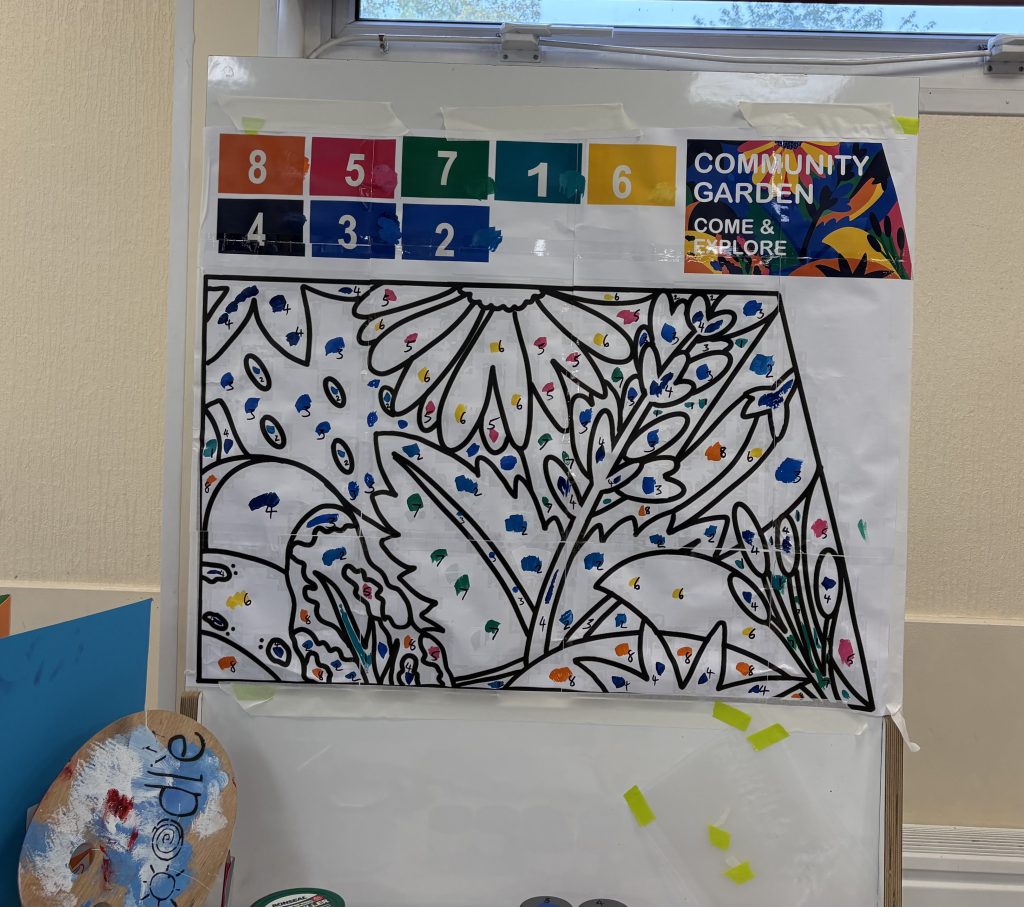
Cue Christina Stavrindes and Doodle, an award-winning organisation connecting communities through art, craft and design. With Christina’s guidance, signs to be placed around the estate have been co-designed by current garden volunteers, pupils from St John and St James’s primary school and young people engaged by Youth Services, all working together. The signs were painted with the help of residents attending a Family Fun Day at Joyce & Snell’s (on a rather wet and otherwise miserable afternoon which was actually perfect for indoor creativity). The design is joyfully colourful and includes stylised representations of flowers and produce grown in the garden. Crucially, the language of the sign was carefully considered and voted on by those involved. The wording chosen was “Come and explore”. The idea behind this is to indicate an experience which will be in the control of whoever does come along. And it hints at adventure. What’s more, it’s consistent with research evidence that using the language of shared endeavour, where every participant has agency, is more successful than language which implies “opening up” of a space to others by a pre-existing group.
The next step is for residents to choose where on the estate to place the signs and make sure that people living further away from the garden see it as belonging to them as much as to those living close by.
Particular thanks to Donna Carr (West and North London ICB) for sharing evidence of successful strategies for inclusive green space projects.
Watch the 5-minute film we commissioned from Enfield-based Exploring Cultural Lives CIC to showcase Grow Joyce & Snell’s and its positive effect on gardeners and visitors.
